Topics
Understanding ice albedo feedback
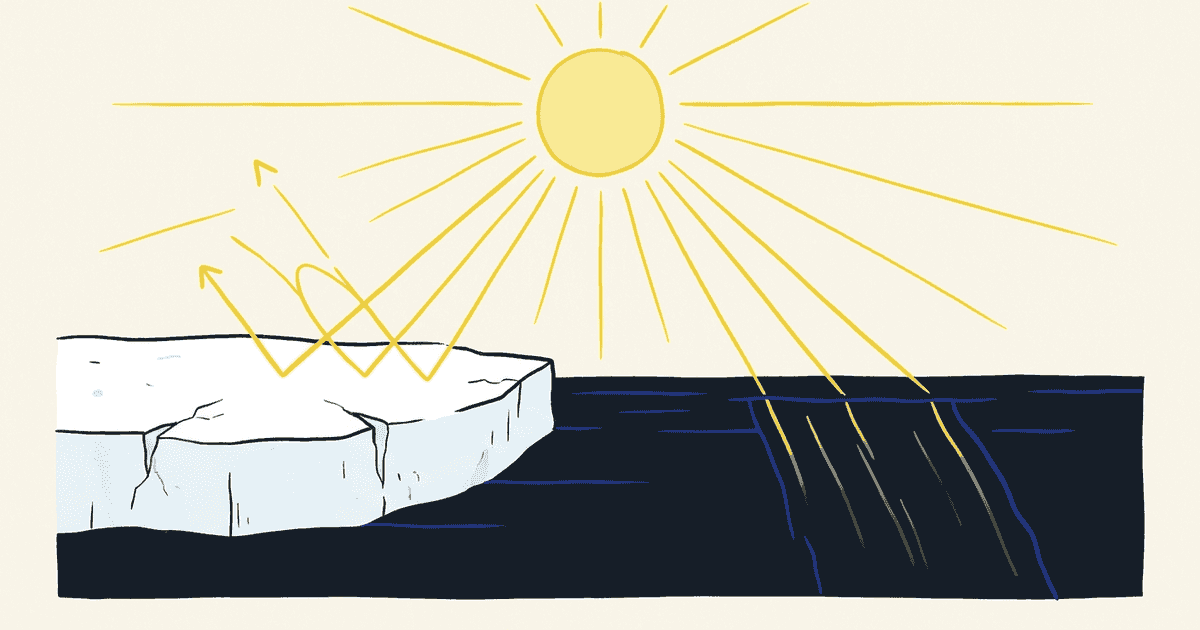
Ice albedo feedback is a climate mechanism that can amplify Earth's warming or cooling. Ice and snow are highly reflective. They bounce a large fraction of incoming solar radiation back to space. When ice melts, the darker surface beneath absorbs more sunlight. The extra heat then melts more ice. This creates a reinforcing cycle: less ice leads to more warming, which causes more ice to melt.
The mechanism also works in reverse. A small cooling triggers more ice and snow to grow. More ice reflects more sunlight. More reflection causes more cooling, which grows more ice. This feedback can shift Earth's climate between two very different stable states. The same amount of solar energy can support an ice-covered planet or an ice-free planet, depending on which state the climate occupies.
1.What the simulation shows
The ice albedo simulation models how Earth's energy balance responds to changes in ice coverage. Students adjust how much solar energy reaches Earth and observe the model's response in real time. The simulation reveals tipping points, where small changes in solar energy trigger rapid shifts from one climate state to another.
Students can explore scenarios from Earth's history, such as when the planet may have been covered almost entirely in ice (Snowball Earth). They discover that the same solar input can support two stable climates: one with substantial ice coverage and one with minimal ice. This interactive model demonstrates why feedback mechanisms are critical to understanding both past climate change and present-day climate dynamics.
2.Grade bands: Middle School and High School
The simulation serves students in grades 6-12. Middle School students explore how changes in surface reflectivity affect climate. High School students use the model to analyze the quantitative relationship between energy flow and climate state, and to investigate how feedback mechanisms can lock Earth into different climate regimes.
3.Standards: HS-ESS2-2, HS-ESS2-4, and MS-ESS3-5
The simulation supports three NGSS standards.
HS-ESS2-2 (Earth Materials and Systems): Analyze geoscience data to make the claim that one change to Earth's surface can create feedbacks that cause changes to other Earth systems.
HS-ESS2-4 (Weather and Climate): Use a model to describe how variations in the flow of energy into and out of Earth's systems result in changes in climate.
MS-ESS3-5 (Global Climate Change): Ask questions to clarify evidence of the factors that have caused the rise in global temperatures over the past century.
4.How to assign it
Start a new class session in the teacher dashboard. The system generates a unique join code. Students enter the code on the join screen with no login required. The simulation appears immediately, and students can begin the assignments. Teachers see a live results view that updates as students submit answers. All responses are saved automatically, and the teacher can review student work anytime.
Questions teachers ask
What is albedo?
Albedo is the fraction of sunlight that a surface reflects back to space. Ice and snow have high albedo, meaning they reflect most sunlight. Darker surfaces like ocean water and bare rock have low albedo, meaning they absorb most sunlight.
What does Snowball Earth mean?
Snowball Earth is a scientific hypothesis that Earth's surface was covered almost entirely by ice and snow at certain times in the distant past. This reflectivity feedback may have locked the planet into this state. The simulation lets students explore how such a frozen planet could have become habitable again.
Why does the simulation show two different climates for the same amount of sunlight?
This feedback mechanism creates multiple stable climate states. The same solar energy input can result in either a frozen planet or an ice-free planet, depending on starting conditions and how ice coverage changes over time. This is a real aspect of Earth's climate system.
Do students need to create accounts to use the simulation?
No. Students join a class session using a code with no login, password, or account creation needed. Teachers create the session and manage it from the teacher dashboard.
Does the simulation work on Chromebooks and tablets?
Yes. The simulation runs in any modern web browser on Chromebooks, iPads, laptops, and desktop computers. It requires no software installation.
Standards
Try the simulations
Ice & Albedo: Earth's Energy Balance
More resources
Use this resource to teach with live results